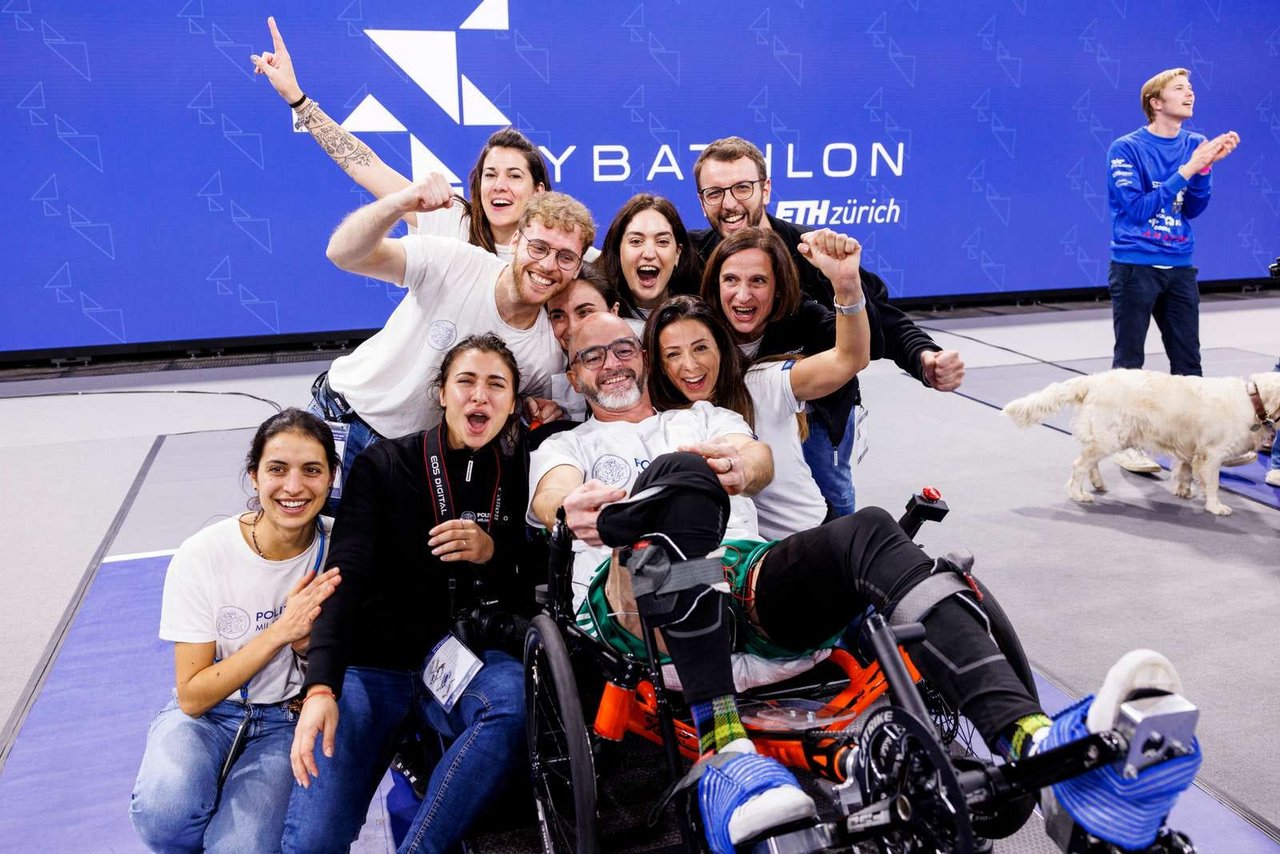

Cybathlon is an international competition comprising eight different disciplines: during the competitions, people with disabilities compete in performing everyday tasks using state-of-the-art assistive technologies developed and optimised by the teams. The team from Politecnico di Milano participates in the FES-bike (Functional Electrical Stimulation Bike) discipline, in which a rider with complete paraplegia runs using a passive trike and an electrical muscle stimulator capable of sending trains of coordinated impulses through surface electrodes that induce the contraction of paralysed muscles. The participating teams are required to optimise the mechanics and seating of the trike of a commercial system, install the sensors on the trike, define and optimise the pacing strategy, transfer the control system to an embedded system and develop the user interface and diagnostics software.
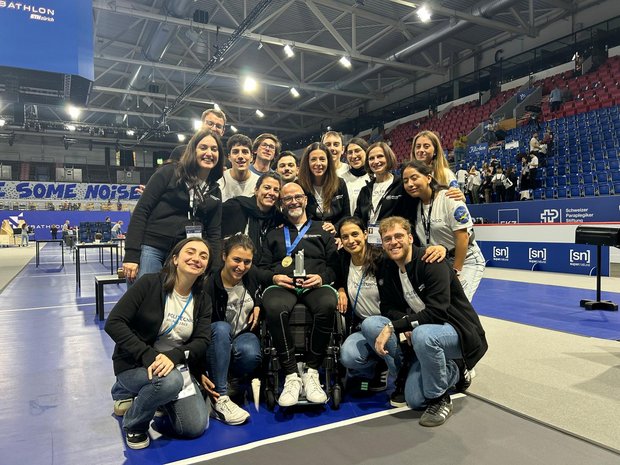
The Polimi Team
In 2019, a group of researchers and students began designing the first prototype of the FES bike. Since then, Polimi FES bike Team has worked consistently to optimize the device and its performance. After participating in two editions of Cybathlon (2020 and 2024) and several satellite competitions to test the prototype and compare it with other groups, the team continues to work on improving the setup, stimulation strategy, user experience, and training methods.
Contacts
To be updated on all the news, follow the Instagram page (https://www.instagram.com/polimi_fesbike/?igshid=MzRlODBiNWFlZA%3D%3D) or the LinkedIn (https://it.linkedin.com/company/festrike-polimi).
For information, you can send an email to emilia.ambrosini@polimi.it and nicole.sanna@polimi.it.
Meet the Polimi FES Bike Team!
WHO IS PART OF THE TEAM?
The Polimi FES Bike Team is made up of around 20 students from the Politecnico di Milano, mainly enrolled in Biomedical Engineering, while some are studying Mechanical and Aerospace Engineering. The team is organized into three main subgroups: the hardware team, the software team, and the training team.
The training team is responsible for preparing our pilot by having him train with the trike we designed, helping him gain as much confidence as possible and achieve the best results. The hardware team focuses mainly on the mechanical side of the trike, while the software team develops the control system.
We also have an additional group: the Communication team, responsible for organizing events such as interviews and photoshoots, as well as promoting our team and activities.
To take part in FES-cycling competitions, teams must race with a pilot affected by a spinal cord injury causing paralysis of the lower limbs. Throughout our journey as a team, we have collaborated with several pilots who have accompanied us in different competitions.
WHEN WAS THE TEAM FOUNDED AND HOW HAS IT EVOLVED OVER TIME?
The team was founded in 2019 under the guidance of Professor Ambrosini, who has worked on Functional Electrical Stimulation applications in neurorehabilitation since her PhD studies. From this experience came the idea that participating in a competition could enrich students’ education by giving them a concrete goal to work toward.
Over the following years, we participated in the Cybathlon in both 2020 and 2024. Besides Cybathlon, we also took part in other FES-cycling competitions, particularly those held in Lyon around September, known as the “Lyon Cyber Days,” where we raced with our trike.
These events are especially meaningful because, beyond the competition itself, there is a strong sense of exchange between teams. For example, both at Cybathlon and in Lyon, we had the chance to try other teams’ trikes, while other pilots tested ours, creating a collaborative and inspiring atmosphere.
An important contribution to the team’s activities also came from several research projects, including the FESleg project, developed in collaboration with the INAIL Prosthetics Center, and the Active3 project, funded by Regione Lombardia and Fondazione Cariplo.
WHAT IS THE TEAM’S MAIN ACTIVITY AND HOW DOES THE WORK DEVELOP DURING THE YEAR?
Since we are divided into different teams, each group’s activities depend on its specific goals.
Within the training group, which works most closely with the pilot, we meet weekly. A typical training day starts with the pilot arriving at our lab around 10 a.m. We first record his physiological parameters, after which he gets onto the trike and we place the electrodes on his lower limbs.
Once these preliminary steps are completed, we begin our training protocol, which changes throughout the semester. Every month we meet to define a protocol suited to achieving specific objectives.
The latest Cybathlon races were held indoors, with the trike mounted on a roller system. Our current goal, however, is to bring the trike outdoors onto a real track. The trike is already designed as a mobile outdoor device, but our work now focuses on optimizing it to make outdoor use safer and more efficient.
This naturally presents new challenges, such as increasing the pilot’s endurance and improving the trike itself. At the same time, the pilot also needs more intensive training, since outdoor riding involves much greater resistance compared to indoor sessions.
WHAT IS THE SECRET THAT KEEPS THE TEAM UNITED?
Within the Polimi FES Bike Team there are many different aspects to work on: mechanics, computer science, and electronics. Having people from different academic backgrounds helps us enormously because it brings together different perspectives.
This diversity is what keeps us united. We are a very dynamic team, we get along well with each other, and even with our pilot the atmosphere is always light-hearted and friendly. We can truly say that every time we come to training and work together, we are happy to be there.
WHAT IS THE FARTHEST CITY WHERE YOU HAVE COMPETED?
Besides participating in the Cybathlon, organized in Zurich every four years, we have also competed in other FES-cycling events, particularly the Lyon Cyber Days held in Lyon.
ARE THERE ANY FUNNY MEMORIES OR UNEXPECTED EVENTS YOU REMEMBER?
Our greatest achievement so far was winning third place at Cybathlon 2024, something we worked incredibly hard for. It brought immense joy both to us and to our pilot, who dedicated himself completely to this goal.
We can do all the work we want on the trike, but without him our team would not be complete.
During the final race, something unexpected happened: our pilot accidentally pressed the wrong button. Instead of activating what we called the “boost” — a stronger current for the legs — he pressed the “stop” button. For two seconds that felt like an eternity, the trike completely stopped. Fortunately, we managed to restart and everything ended well: we finished the race and reached the target distance required by the competition.
WHAT ARE THE NEXT GOALS?
Our team wants to further improve the trike in order to optimize its outdoor performance. The trike is already designed for outdoor tracks, but there are still improvements to be made both in pilot training and in the trike setup, since outdoor environments involve many more variables.
As for Cybathlon, the main competition takes place every four years, so there will not be another edition in the immediate future. However, other competitions are organized throughout the year, allowing teams to upload records achieved over various distances to an online platform. We are currently preparing to register our own records. These events are called the “AT Records.”
WHY SHOULD SOMEONE JOIN THE TEAM?
There are three main reasons why we would recommend joining this team.
First of all, it gives students the opportunity to apply in practice what they have studied in books and lectures.
Secondly, it creates meaningful connections with people - not only with students from different degree programs, but also with our pilot. This has been an extremely important aspect of the team. We work very closely with him, and everything we develop is based on his feedback, making collaboration essential.
The third reason is the opportunity to challenge yourself, work toward concrete goals, and collaborate with others to achieve shared objectives.