

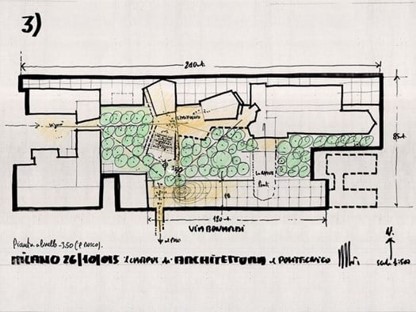
In recent years, the Politecnico di Milano has undergone significant urban and architectural renovations to meet the changing demands of a society and Politecnico community experiencing continuous transformations. The result is an open and inclusive campus marked by a close relationship between the university and urban setting. The university therefore acts as a key figure in social rebirth aimed at breaking down barriers between the centre and the outskirts, placing students at the centre of the growing urban fabric in clear continuity with the city and the history of the places. This design capability is expressed by means of internal personnel — building technicians, professors and researchers — and through the essential contribution of external excellence, with Renzo Piano and his prestigious firm as the main expression of this.
5 pillars of the Politecnico
- Inclusion: Uninterrupted open and confined spaces are conceived as fluid places for socialising, studying and free time.
- Memory: Built in 1927, the current Politecnico complex requires enhancement and functional updates that project historical features into the future.
- Innovation: Reflecting the DNA of the Politecnico, innovations in products and processes are the key to understanding every technical-scientific project.
- Sustainability: The most up-to-date sustainability criteria, interpreted in multiple senses, are the common thread running through every action to transform the built environment.
- Architecture: The idea of distinguishing the spirit of the Politecnico through architecture and its semantics and language is the primary goal of every design and construction activity.
ViviPolimi
Managing the architectural and urban transformation of the two campuses in Milan has led to ViviPolimi, a strategic project started in 2019, aimed at improving the quality of spaces used for working, research and teaching at the Politecnico di Milano. This project has been an important step towards a future in which the university is not only a place for learning, but also an integral and dynamic element of the city, capable of interacting and growing in step with the surrounding urban community. The reorganisation of the Politecnico di Milano campuses is a model of excellence that combines architecture, sustainability and inclusion, carrying the university towards a greener, more interconnected and innovative future.
For more details, follow the video interviews with Ferruccio Resta and Emilio Faroldi:
Ferruccio Resta interview
Emilio Faroldi interview